<?xml version="1.0" encoding="utf-8"?><feed xmlns="http://www.w3.org/2005/Atom" ><generator uri="https://jekyllrb.com/" version="3.10.0">Jekyll</generator><link href="https://blog.dracor.org/feed.xml" rel="self" type="application/atom+xml" /><link href="https://blog.dracor.org/" rel="alternate" type="text/html" /><updated>2026-04-19T09:50:33+00:00</updated><id>https://blog.dracor.org/feed.xml</id><title type="html">DraCor Blog</title><subtitle>News, updates, and writing from the DraCor project, with a focus on DraCorOS. A contribution to the OSCARS project.</subtitle><entry><title type="html">DraCor Platform Update (July 2025)</title><link href="https://blog.dracor.org/posts/dracor-platform-update-2025/" rel="alternate" type="text/html" title="DraCor Platform Update (July 2025)" /><published>2025-07-14T00:00:00+00:00</published><updated>2025-07-14T00:00:00+00:00</updated><id>https://blog.dracor.org/posts/dracor-platform-update-2025</id><content type="html" xml:base="https://blog.dracor.org/posts/dracor-platform-update-2025/"><![CDATA[<ul>
  <li><strong>tl;dr:</strong> Enhanced API, Frontend and Schema, Comprehensive Documentation, and Upcoming Summit in Berlin.</li>
</ul>

<p>After bigger updates in <a href="https://weltliteratur.net/dracor-summer-update-2021/">August 2021</a> and <a href="https://weltliteratur.net/streamlining-the-dracor-api/">December 2023</a>, we are excited to share that DraCor just got another upgrade!</p>

<p>This latest release introduces a wide range of improvements – from enhancements to the API and frontend to refinements in the underlying TEI/XML data model. It is the result of months of collaborative work by our team, all in the spirit of keeping DraCor open, transparent, and easy to hack, build on, and explore. The new features come without any breaking changes.</p>

<p>DraCor was built as an open digital infrastructure for the computational study of European drama – spanning from ancient Greek tragedy to 20th-century theatre. Since our last major technical update, the platform has grown not only in functionality but also in content, thanks in large part to our global community of researchers and enthusiasts who have contributed new corpora. Today, DraCor hosts more than 4,000 plays across nearly 30 corpora, representing over 20 languages – and the platform continues to grow.</p>

<p>Before diving into the roundup of changes, we would like to give credit where it is due. The lion’s share of this update was made possible thanks to the tireless work of our technical lead, Carsten Milling, and co-lead, Ingo Börner. Development was supported through funding from <a href="https://cordis.europa.eu/project/id/101004984">CLS INFRA</a> and <a href="https://oscars-project.eu/projects/dracoros-fostering-open-science-digital-humanities-connecting-dracor-ecosystem-eosc">DraCorOS</a>.</p>

<h2 id="-a-smarter-cleaner-api">💡 A Smarter, Cleaner API</h2>

<p>The DraCor API has seen its most comprehensive revision since the project began. Among the many changes are the following:</p>

<ul>
  <li><strong>DTS Support:</strong> We have implemented a <code class="language-plaintext highlighter-rouge">/dts</code> endpoint to align the API in line with the <a href="https://distributed-text-services.github.io/specifications/">Distributed Text Services (DTS) specification</a>. A DraCor Notebook documenting the new endpoint is available <a href="https://github.com/dracor-org/dracor-notebooks/blob/main/dts/dts.ipynb">here</a>.</li>
  <li><strong>Plaintext Endpoint:</strong> Users can now fetch a plain text version of any play via a dedicated endpoint – making it easier to use DraCor data in NLP pipelines and other tooling.</li>
  <li><strong>Corpus Metadata Enhancements:</strong> We now track Git commit hashes from the corpus repositories, adding another layer of provenance and traceability to our data.</li>
  <li><strong>Improved Filtering:</strong> The <code class="language-plaintext highlighter-rouge">spoken-text</code> endpoint now features refined relation filter parameters, offering more precise ways to query dramatic dialogue.</li>
  <li><strong>Inclusive Metadata:</strong> The API now supports both <code class="language-plaintext highlighter-rouge">sex</code> and <code class="language-plaintext highlighter-rouge">gender attributes</code>, enhancing its ability to reflect diverse encodings of character identity.</li>
  <li><strong>Better Developer Experience:</strong> We have extended and refined our OpenAPI specification, added more comprehensive tests, and introduced a robust CI workflow for building Docker images.</li>
  <li><strong>Upgrades:</strong> Under the hood, we have moved to <strong><a href="https://exist-db.org/">eXist-db</a> 6.4.0</strong> and <strong>dracor-metrics 1.5.1</strong>, improving both performance and maintainability.</li>
</ul>

<p>Full API release notes here: <a href="https://github.com/dracor-org/dracor-api/releases">dracor-api changelog</a>.</p>

<h2 id="️-a-refined-frontend-for-exploration">🖥️ A Refined Frontend for Exploration</h2>

<p>The DraCor frontend has also received a series of upgrades that improve usability and extend functionality:</p>

<ul>
  <li><strong>New “Tools” Tab:</strong> Data from each play can be sent directly to third-party analysis tools, such as Voyant Tools, Gephi Lite or the CLARIN Switchboard.</li>
  <li><strong>Corpus Status Overview:</strong> We have added a <a href="https://dracor.org/doc/corpora">status page</a> that provides an overview of the current state, maintenance responsibilities, and licencing of all DraCor corpora – useful for developers, curators, and researchers alike.</li>
  <li><strong>Rendering Fixes &amp; UI Improvements:</strong> A variety of bugs were squashed, including issues with rendering segment lists. The toolchain has been updated, and we have migrated to <strong>pnpm</strong> for improved dependency management.</li>
</ul>

<p>Full frontend release notes here: <a href="https://github.com/dracor-org/dracor-frontend/releases">dracor-frontend changelog</a>.</p>

<h2 id="-tei-schema-10-a-solid-foundation">🧾 TEI Schema 1.0: A Solid Foundation</h2>

<p>One of the most substantial and long-awaited developments is the release of the <strong>first stable version of the DraCor TEI schema</strong>. It all began during a coffee break at the <strong><a href="https://jcls.io/site/ccls2024/">CCLS 2024</a></strong> in Vienna – and ended in a full overhaul of how we define and validate DraCor corpora. Highlights include:</p>

<ul>
  <li><strong>Based on tei_drama (TEI 4.9.0):</strong> The schema builds on the official TEI customisation for drama, ensuring compatibility with broader TEI ecosystems.</li>
  <li><strong>More Flexibility &amp; Clarity:</strong> We have revised the structure to make it easier for contributors to encode new plays and for the schema to accommodate varied metadata.</li>
  <li><strong>New Elements &amp; Better Validation:</strong> We now support elements such as <code class="language-plaintext highlighter-rouge">&lt;region&gt;</code>, <code class="language-plaintext highlighter-rouge">&lt;orgName&gt;</code>, and <code class="language-plaintext highlighter-rouge">&lt;addName&gt;</code>, and introduced Schematron rules tailored to DraCor’s specific needs.</li>
</ul>

<p>Full schema release notes here: <a href="https://github.com/dracor-org/dracor-schema/releases">dracor-schema changelog</a>.</p>

<h2 id="-comprehensive-documentation">📜 Comprehensive Documentation</h2>

<p>Our contribution to the EU project <a href="https://clsinfra.io/">CLS INFRA</a> is documented in several detailed reports that provide comprehensive insights into DraCor:</p>

<ul>
  <li><strong>D7.1:</strong> The report “On Programmable Corpora” presents DraCor as a prototype for an infrastructural ecosystem of <em>Programmable Corpora</em>, defined as corpora that expose an open, transparently documented, and a research-driven API, enabling machine-actionable access to texts. This concept builds on on Aaron Swartz’s vision of “A Programmable Web” (2013), in which applications form an interoperable, dynamic ecosystem through the “natural growth” of APIs from the resources they make accessible. (<a href="https://doi.org/10.5281/zenodo.7664964">doi:10.5281/zenodo.7664964</a>)</li>
  <li><strong>D7.2:</strong> The “Report on API Libraries for R and Python for the Programmable Corpora Prototype DraCor” introduces the DraCor libraries, (<a href="https://cran.r-project.org/web/packages/rdracor/index.html">rdracor</a> for R and <a href="https://pypi.org/project/pydracor/">pydracor</a> for Python), which provide researchers with direct programmatic access to DraCor’s corpora in their preferred programming language. (<a href="https://doi.org/10.5281/zenodo.15302236">doi:10.5281/zenodo.15302236</a>)</li>
  <li><strong>D7.3:</strong> The report “On Versioning Living and Programmable Corpora” addresses the challenge of ensuring research reproducibility with <em>living corpora</em> by recommending Git-based versioning for dynamic corpora and containerisation for complex programmable corpora infrastructures. (<a href="https://doi.org/10.5281/zenodo.11081934">doi:10.5281/zenodo.11081934</a>)</li>
  <li><strong>D7.4:</strong> The final report of our CLS INFRA work package, “Report on the Implementation of Programmable Corpora”, documents the evolution of DraCor into a standards-compliant, extensively documented service. It now features a stable API (version 1.x), Distributed Text Services (DTS) endpoints, and new tools such as <a href="https://github.com/dracor-org/ezdrama">EzDrama</a> and <a href="https://github.com/dracor-org/epdracor-whois">Who-is-@who</a>, all of which contribute to transforming the experimental prototype into a sustainable piece of European infrastructure for computational literary studies. (<a href="https://doi.org/10.5281/zenodo.15301341">doi:10.5281/zenodo.15301341</a>)</li>
</ul>

<h2 id="-save-the-date-dracor-summit-2025">📅 Save the Date: DraCor Summit 2025</h2>

<p><strong>From 1 to 5 September 2025, the <a href="https://summit.dracor.org/">DraCor Summit</a> will take place in Berlin</strong> – hosted by the Freie Universität Berlin and the University of Potsdam. It will be five days of workshops, talks, a corpora conference, a computational drama analysis workshop, a barcamp, and even co-working time. The Summit is open to anyone working in or curious about computational literary studies, corpus development, or cultural analytics. There is no registration fee. General registration opened on 6 June – we would love to see you there!</p>

<h2 id="-follow-the-drama">🧭 Follow the Drama</h2>

<p>To stay up to date with DraCor news, project updates, and community events, subscribe to <a href="https://www.listserv.dfn.de/sympa/info/dracormailinglist">our mailing list</a> and follow the official <a href="https://bsky.app/profile/dracor.org">DraCor account on Bluesky</a>.</p>

<p class="ai-note"><em>(Portions of this blog post were composed with assistance from Claude Opus 4.)</em></p>]]></content><author><name>[&quot;lehkost&quot;, &quot;cmil&quot;, &quot;ingoboerner&quot;, &quot;juliajbeine&quot;, &quot;peertrilcke&quot;]</name></author><summary type="html"><![CDATA[Enhanced API, Frontend and Schema, Comprehensive Documentation, and Upcoming Summit in Berlin. The first major DraCor platform update in the context of DraCorOS.]]></summary></entry><entry><title type="html">Announcing DraCorOS: DraCor Joins OSCARS</title><link href="https://blog.dracor.org/posts/announcing-dracoros/" rel="alternate" type="text/html" title="Announcing DraCorOS: DraCor Joins OSCARS" /><published>2025-01-01T08:00:00+00:00</published><updated>2025-01-01T08:00:00+00:00</updated><id>https://blog.dracor.org/posts/announcing-dracoros</id><content type="html" xml:base="https://blog.dracor.org/posts/announcing-dracoros/"><![CDATA[<p>We are very pleased to announce that our project has been selected for funding by <a href="https://oscars-project.eu/">OSCARS</a> — the EU-funded project that “strives to foster the uptake of Open Science in Europe by consolidating the achievements of world-class European research infrastructures in the ESFRI roadmap and beyond into lasting interdisciplinary FAIR data services and working practices”.</p>

<p>Our project — <strong><a href="https://oscars-project.eu/projects/dracoros-fostering-open-science-digital-humanities-connecting-dracor-ecosystem-eosc">DraCorOS: Fostering Open Science in Digital Humanities by connecting the “DraCor” Ecosystem to EOSC</a></strong> — runs for <strong>24 months, starting 1 January 2025</strong>. It is coordinated by the <strong>University of Potsdam</strong>, with <strong>Freie Universität Berlin</strong> as a partner. The principal investigator is <strong>Peer Trilcke</strong>; the project team also includes <strong>Frank Fischer</strong>, <strong>Ingo Börner</strong>, and <strong>Antonio Rojas Castro</strong>.</p>

<h2 id="what-will-dracoros-do">What will DraCorOS do?</h2>

<p>DraCorOS builds on DraCor, our community-driven platform for the computational study of drama, along three lines of work:</p>

<ol>
  <li><strong>Enhanced discoverability.</strong> We will transform DraCor into a semantically enriched Linked Open Data environment and integrate it with the <a href="https://eosc.eu/">European Open Science Cloud (EOSC)</a>, so DraCor corpora and services become visible, citable, and reusable alongside other European research infrastructures.</li>
  <li><strong>Open Science promotion.</strong> We will deliver training and workflows that advance FAIR-data practices in <strong>Computational Literary Studies</strong> — addressing researchers who are building, curating, or analysing dramatic corpora, with particular attention to small and under-resourced European languages.</li>
  <li><strong>Software development.</strong> We will continue to evolve the DraCor platform’s <em>Programmable Corpora</em> architecture as a standalone piece of open-source software, so that other disciplinary communities can adopt and adapt it for their own corpora.</li>
</ol>

<h2 id="watch-the-project-pitch">Watch the project pitch</h2>

<div class="video-embed">
  <iframe src="https://www.youtube-nocookie.com/embed/zHBpN07r-5U" title="DraCorOS project pitch" frameborder="0" allow="accelerometer; autoplay; clipboard-write; encrypted-media; gyroscope; picture-in-picture; web-share" referrerpolicy="strict-origin-when-cross-origin" allowfullscreen=""></iframe>
</div>

<h2 id="about-this-blog">About this blog</h2>

<p>This blog, <strong><a href="https://blog.dracor.org">blog.dracor.org</a></strong>, is itself an output of DraCorOS. We will use it to share project news, technical updates around DraCor in the context of DraCorOS, reports from workshops and community events, notes on our work on Linked Open Data, EOSC integration, and Open Science tooling for drama research, as well as updates on our teaching and training materials. Cross-posts from other sources, e.g. Frank Fischer’s long-running <a href="https://weltliteratur.net">weltliteratur.net</a> blog, will be clearly marked as such.</p>

<p>Subscribe to the <a href="/feed.xml">RSS feed</a>, follow <a href="https://bsky.app/profile/dracor.org">@dracor.org on Bluesky</a>, or join our <a href="https://www.listserv.dfn.de/sympa/info/dracormailinglist">mailing list</a> to keep up with the project.</p>

<p>Here’s to two years of open, programmable, and genuinely findable drama corpora. 🎭</p>]]></content><author><name>[&quot;peertrilcke&quot;, &quot;lehkost&quot;, &quot;ingoboerner&quot;, &quot;arojascastro&quot;]</name></author><category term="DraCorOS" /><summary type="html"><![CDATA[DraCor has been selected for funding by the EU-funded OSCARS project. Over the next 24 months, DraCorOS will connect the DraCor ecosystem to EOSC, deepen its Open Science commitments, and open the platform up for reuse beyond drama corpora.]]></summary></entry><entry><title type="html">Streamlining the DraCor API</title><link href="https://blog.dracor.org/posts/streamlining-the-dracor-api/" rel="alternate" type="text/html" title="Streamlining the DraCor API" /><published>2023-12-01T00:00:00+00:00</published><updated>2023-12-01T00:00:00+00:00</updated><id>https://blog.dracor.org/posts/streamlining-the-dracor-api</id><content type="html" xml:base="https://blog.dracor.org/posts/streamlining-the-dracor-api/"><![CDATA[<h2 id="again-what-is-dracor">Again, What Is DraCor?</h2>

<p>DraCor, the Drama Corpora platform, is an infrastructure built to facilitate the digital research on European drama. We have currently 25 (!) TEI-encoded DraCor corpora in 19 (!) languages/dialects:</p>

<ul>
  <li>Alsatian, Bashkir, Czech, Dutch, English, French, German, (Ancient) Greek, Hebrew, Hungarian, Italian, Latin, Polish, Russian, Spanish, Swedish, Tatar, Ukrainian, Yiddish</li>
</ul>

<p>16 of these corpora are already running on our production server (<a href="https://dracor.org/">dracor.org</a>), the others are still in the development phase and will be released when ready. Some corpora (like the Shakespeare corpus) have a stable number of plays. Depending on the corpus strategies of their maintainers, other corpora can generally grow and be updated with new plays. We call them ‘living corpora’.</p>

<h2 id="dracor-api-10">DraCor API 1.0</h2>

<p>The TEI-encoded plays are stored in an <a href="http://exist-db.org/">eXist database</a>. Various encoding layers are extracted and made available via our API: customised data for individual research purposes. You can easily access the full text or text slices (a list of characters, spoken texts, stage directions) or co-occurrence networks. All API endpoints <a href="https://dracor.org/doc/api">are documented</a> following the OpenAPI specification.</p>

<p>A little bit of history. The DraCor API has grown organically ever since we introduced it sometime in August 2017. Yet the first publicly documented release on GitHub was <a href="https://github.com/dracor-org/dracor-api/releases/tag/v0.72.0">0.72.0</a> in September 2020.</p>

<p>New endpoints were added on a frequent basis and made DraCor what it is today, a research-prone platform serving data for computational literary studies. We always tried to use meaningful names and adhere to naming patterns, but over the years some inconsistencies have slipped in.</p>

<p>Henny Sluyter-Gäthje revisited the consistency of names when working on her pydracor library, a wrapper for DraCor API endpoints (<a href="https://github.com/dracor-org/dracor-api/issues/186">see GitHub ticket</a>). Building on her work, we revised the DraCor API, making it more consistent and sustainable.</p>

<p>This work took a lot of time and after the streamlined API has worked well on our staging server for a while now, we release today the first version of the DraCor API that we consider stable, <a href="https://github.com/dracor-org/dracor-api/releases">our 1.0.0</a>.</p>

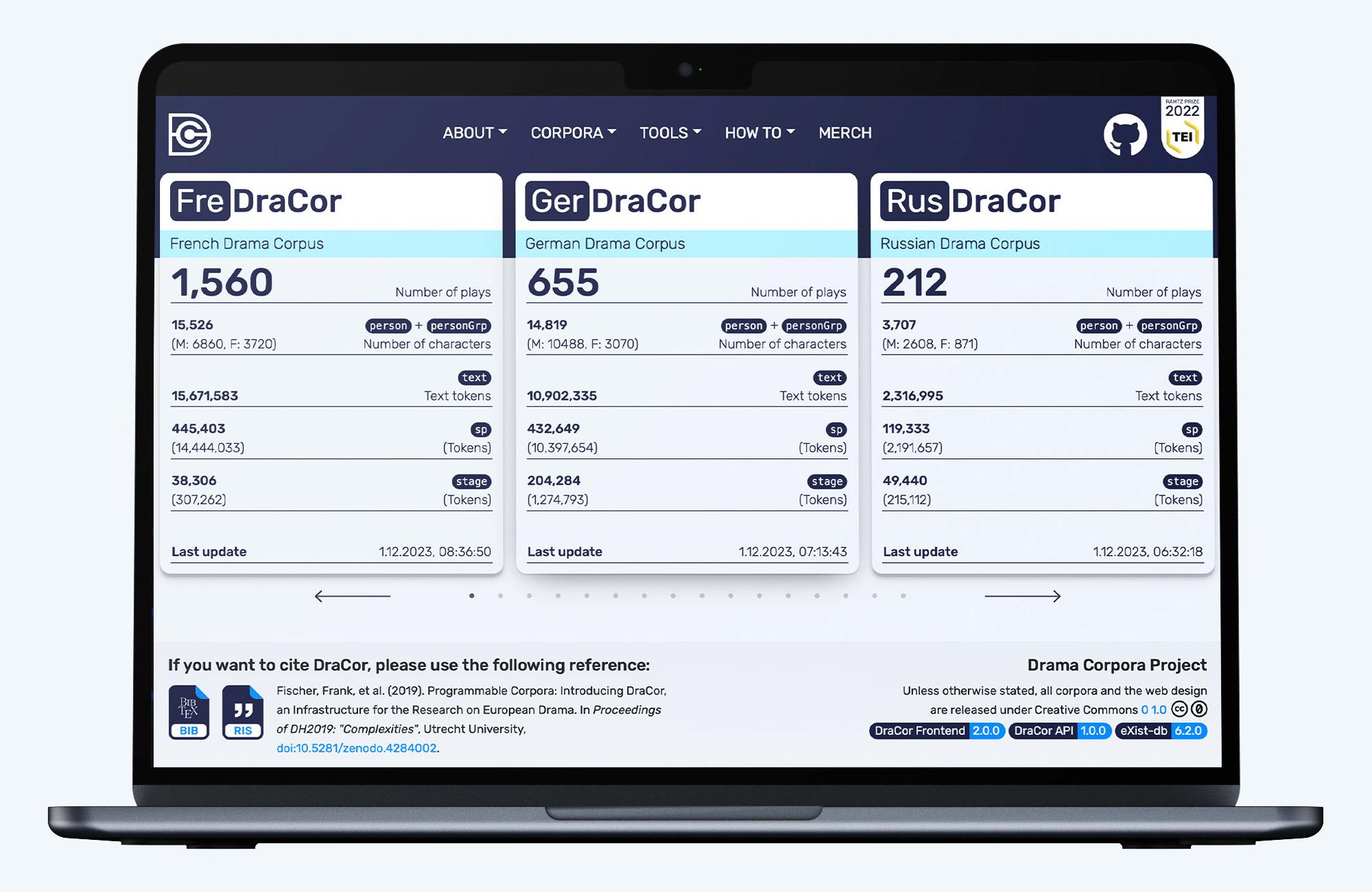
<figure style="text-align:center;">
  <img src="https://weltliteratur.net/images/dracor/dracor-mockup-2023.jpg" alt="DraCor Mockup 2023" style="width:600px; border: 1px solid transparent; border-color: black;" />
</figure>
<center><p style="font-size: 16px; line-height: 24px;"><b>Fig. 1.</b> This mockup is part of the new <b><a href="https://dracor.org/doc/media-kit">DraCor Media Kit</a></b> by Mark Schwindt, released along with the new API version.</p></center>

<h2 id="legacy-api">Legacy API</h2>

<p>From here on out, we would like that everyone who works with the DraCor API to use version 1.x. The URL paths on dracor.org now have a <code class="language-plaintext highlighter-rouge">/v1</code> prefix (e.g., <code class="language-plaintext highlighter-rouge">https://dracor.org/api/v1/info</code>).</p>

<p>However, the last pre-release version of the API will remain to be available under URLs featuring a <code class="language-plaintext highlighter-rouge">/v0</code> prefix (e.g., <code class="language-plaintext highlighter-rouge">https://dracor.org/api/v0/info</code>). Old URLs without a version prefix will be redirected to the versioned ones. For instance, <code class="language-plaintext highlighter-rouge">https://dracor.org/api/info</code> now redirects to <code class="language-plaintext highlighter-rouge">https://dracor.org/api/v0/info</code>. This should allow old scripts to function as long as they follow the redirect.</p>

<p>We plan to keep the API version 0.x available for at least a year. After this period, we may phase it out so as not to have to maintain multiple versions of the API indefinitely. Also see <a href="https://dracor.org/doc/faq">dracor.org/doc/faq</a>.</p>

<h2 id="pydracor-and-rdracor">pydracor and rdracor</h2>

<p>Our API wrappers will be updated to work with our API version 1.0.</p>

<p>pydracor 2.0.0 is already available <a href="https://pypi.org/project/pydracor/">via PyPI</a>, the updated rdracor will be available <a href="https://cran.r-project.org/web/packages/rdracor/index.html">via CRAN</a>.</p>

<h2 id="other-updates">Other Updates</h2>

<p>We introduced a new <code class="language-plaintext highlighter-rouge">/wikidata/mixnmatch</code> endpoint to automatise the integration of DraCor permalinks into Wikidata. A corresponding <a href="https://www.wikidata.org/wiki/Wikidata:Property_proposal/DraCor_ID">DraCor property</a> was also proposed and we wait for approval.</p>

<p>We retired the <code class="language-plaintext highlighter-rouge">/corpora/{corpus}/plays/{play}/segmentation</code> endpoint so as to reduce redundancies (the same information can be obtained via the <code class="language-plaintext highlighter-rouge">/corpora/{corpus}/plays/{play}</code> endpoint).</p>

<p>For now, the RDF endpoint has been removed from the OpenAPI specification as it needs more work. This is something we prioritise and plan to release rather sooner than later, probably with a 1.1 release of our API.</p>

<p>With this release, we also updated our eXist-db from 6.0.1 to 6.2.0.</p>

<h2 id="the-team-behind-the-update-">The Team Behind the Update …</h2>

<p>… includes Carsten Milling, Henny Sluyter-Gäthje, Ingo Börner, Peer Trilcke, Daniil Skorinkin (all University of Potsdam), Frank Fischer, Viktor J. Illmer, Mark Schwindt, Julia Beine, Heinz-Alexander Fütterer (all Freie Universität Berlin) and Ivan Pozdniakov. The implementation was largely carried out as part of the “CLS INFRA” project (<a href="https://cordis.europa.eu/project/id/101004984">funded through EU’s Horizon 2020 programme</a>) and the Cluster of Excellence “EXC2020 Temporal Communities” (<a href="https://gepris.dfg.de/gepris/projekt/390608380">funded through DFG</a>).</p>

<p>DraCor was founded as a community project and, as always, numerous friends and colleagues have contributed feedback and ideas while working on their corpora or conducting research based on data from DraCor.</p>

<p>The platform, <a href="https://web.archive.org/web/20200119005611/https://twitter.com/eumanismo/status/1218066125969412096">once praised</a> for its original guerilla strategy – although this is debatable 😊 – has become a well-frequented part of the international research infrastructure. We trust that this API 1.0 release will contribute to making digital research on European drama (and beyond) more reliable and sustainable.</p>

<p>Goodbye for now, may your requests be valid, your responses swift, and your status codes always successful!</p>]]></content><author><name>[&quot;lehkost&quot;, &quot;cmil&quot;, &quot;markschwindt&quot;]</name></author><summary type="html"><![CDATA[The DraCor API reaches version 1.0.0 — streamlined, consistent, and ready for sustainable research use. The legacy API remains available under /v0.]]></summary></entry><entry><title type="html">DraCor Summer Update (August 2021)</title><link href="https://blog.dracor.org/posts/dracor-summer-update-2021/" rel="alternate" type="text/html" title="DraCor Summer Update (August 2021)" /><published>2021-08-05T00:00:00+00:00</published><updated>2021-08-05T00:00:00+00:00</updated><id>https://blog.dracor.org/posts/dracor-summer-update-2021</id><content type="html" xml:base="https://blog.dracor.org/posts/dracor-summer-update-2021/"><![CDATA[<p><img src="https://weltliteratur.net/images/dracor/dracor-2021-mobile-mockup-05.jpg" alt="DraCor 2021" /></p>

<p>DraCor, the <strong>Dra</strong>ma <strong>Cor</strong>pora platform, can be accessed at <a href="https://dracor.org/">dracor.org</a>. Our aim is to provide an infrastructure component for computational literary studies in order to facilitate access to relevant research data and to ensure compliance with the <a href="https://www.go-fair.org/fair-principles/">FAIR Principles</a> when dealing with literary corpora. In our case, the focus is of course on drama and theatre, but we plan to extend our concept of <a href="https://doi.org/10.5281/zenodo.4284002">Programmable Corpora</a> to novels as part of the H2020-funded <a href="https://cordis.europa.eu/project/id/101004984">CLS INFRA</a> project that started earlier this year.</p>

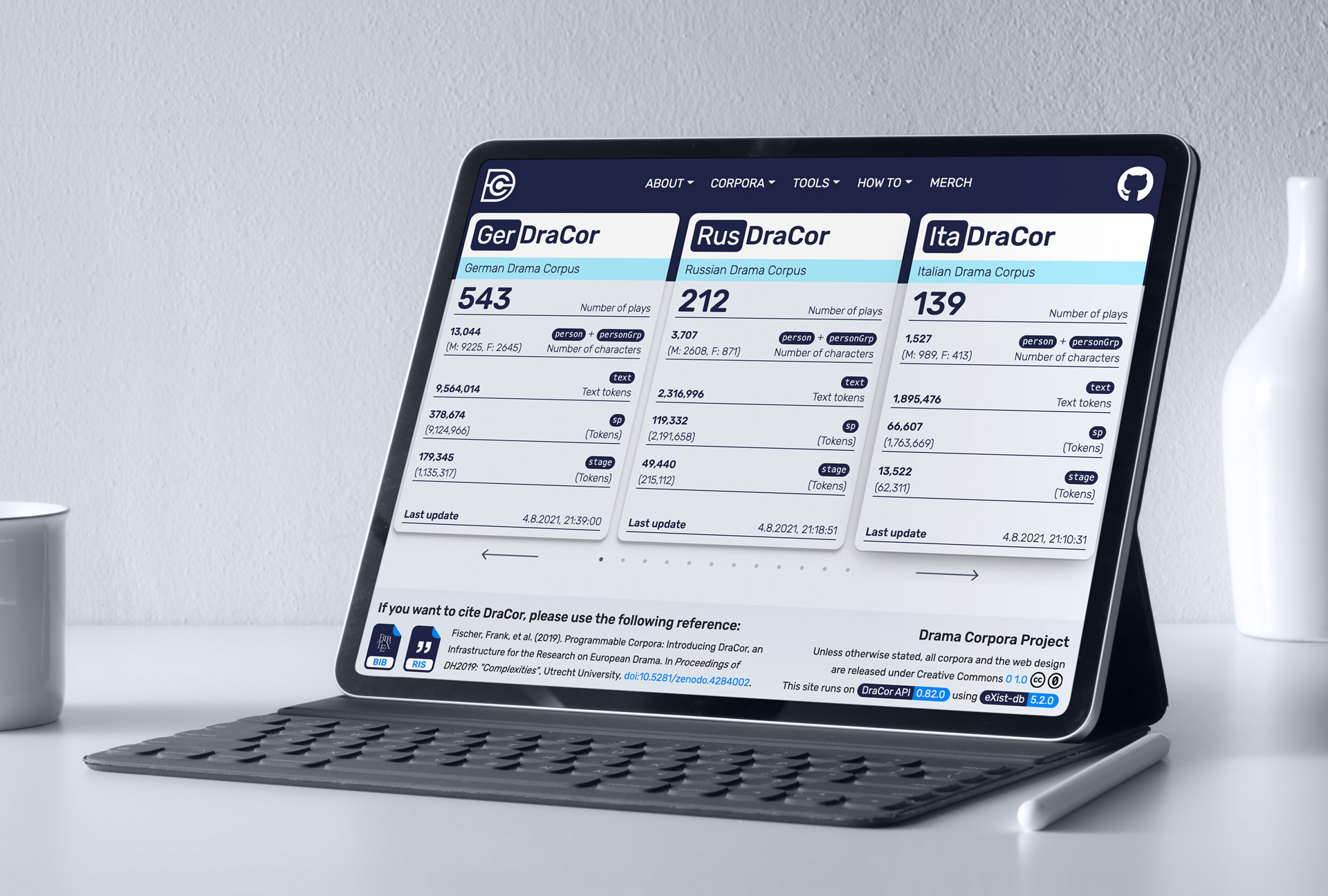
<p>Today, we are pleased to introduce the next iteration of our DraCor website, along with new API functions that make it much easier to access our data for research. Our front-end, i.e. web design, is now at <a href="https://github.com/dracor-org/dracor-frontend/releases/">version 1.1.0</a>, the DraCor-API at <a href="https://github.com/dracor-org/dracor-api/releases/">version 0.82.0</a>.</p>

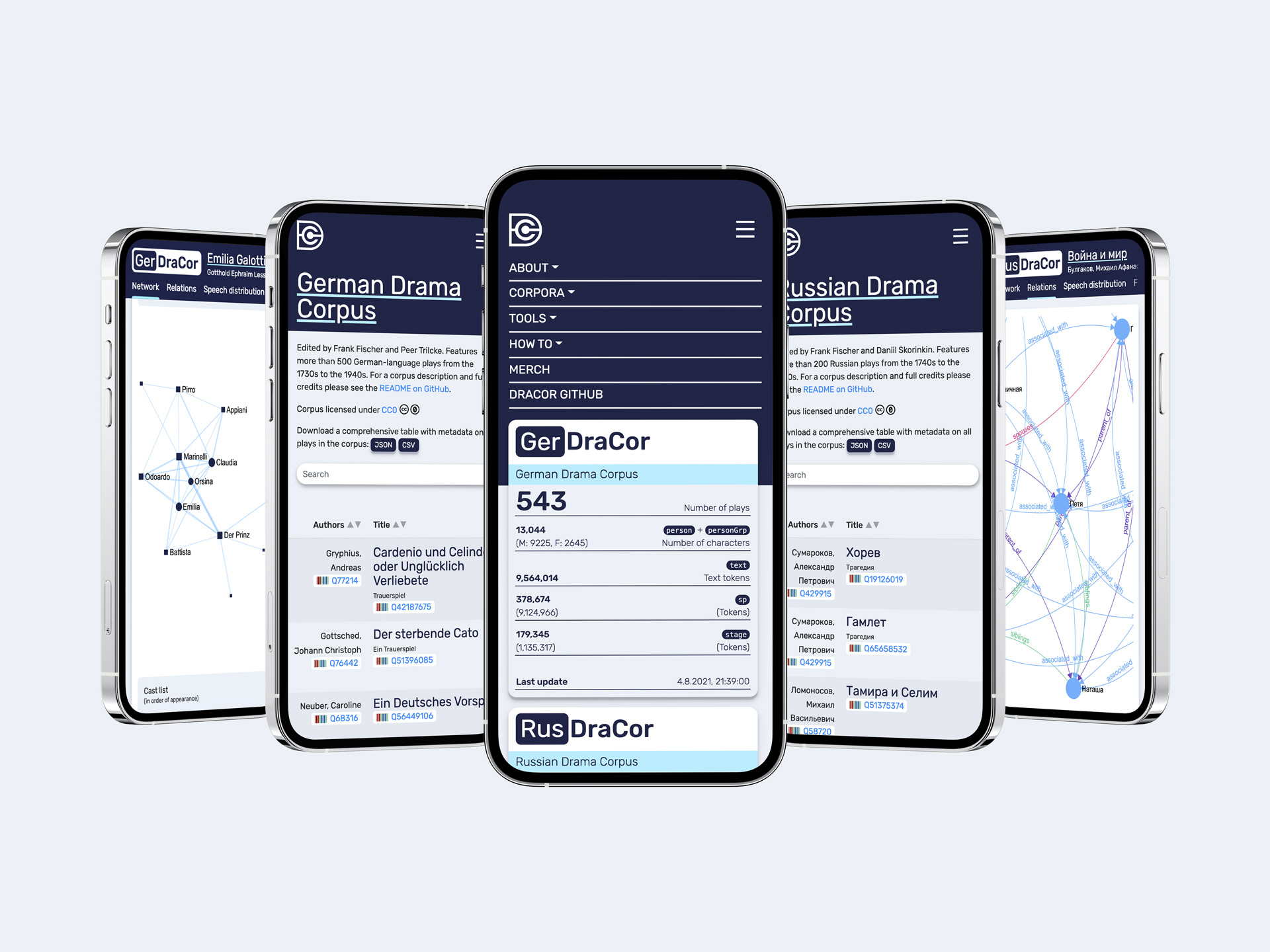
<p>We have worked on all levels of the website, the homepage, the corpus overviews and pages of individual plays:</p>

<figure style="text-align:left;">
  <img src="https://weltliteratur.net/images/dracor/dracor-2021-mobile-mockup-01.jpg" alt="" style="width:49%;" />
  <img src="https://weltliteratur.net/images/dracor/dracor-2021-mobile-mockup-03.jpg" alt="" style="width:49%;" />
</figure>

<p>As before, the website should work well on all types of devices, large screens, laptops, tablets and mobile phones. There are many small details to discover in the new design (our favourites are the author images that we automatically retrieve from Wikimedia Commons via Wikidata QIDs, just one small example of the benefits of our highly interoperable approach).</p>

<p>The overall design is even better aligned with the TEI encoding on which all our corpora are based to increase the visibility of our rich annotations.</p>

<p>Here’s a non-exhaustive summary of the new functions added since December 2020:</p>

<ul>
  <li>infoboxes are now context-sensitive (their content differs depending on which tab is activated: “Network”, “Relations”, “Speech distribution”, “Full text”, or “Downloads”)</li>
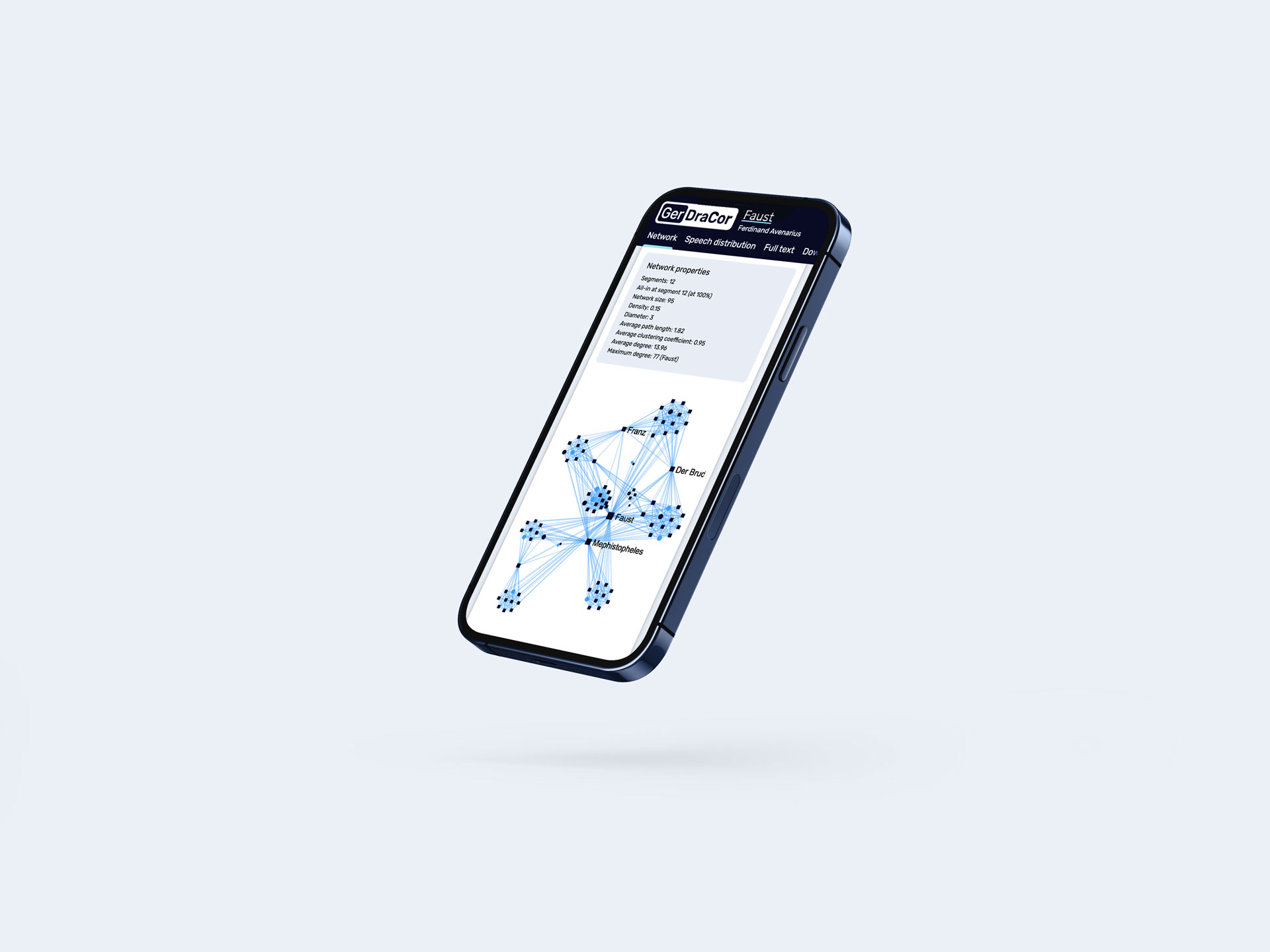
  <li>more explanations on the spot, e.g. the “Network” tab is accompanied by a short description of what the network graph actually shows</li>
  <li>we also introduced an ℹ️ symbol that leads to longer explanations in our newly introduced (and still somewhat empty) FAQ section</li>
  <li>author information and images sourced live from Wikimedia Commons via Wikidata identifiers</li>
  <li>improved readability of network graphs (annotated information on gender is now integrated, colour contrast has been increased)</li>
  <li>plays with historical or mythological characters now display a Wikidata QID if available, a new feature provided by our API (not all corpora are yet encoded with this information, but once they are, it will be much easier to compare all plays with e.g. a Faust character or to do a contrastive analysis of the vocabulary of mythological and historical characters in different authors and even between corpora in different languages)</li>
  <li>the “Full text” tab now shows the print source in the context box, along with an overview of speaking characters per segment</li>
  <li>corpus metadata is now much more accessible, you can download it directly from the corpus overviews (try the CSV version to create some quick charts in MS Excel or LibreOffice Calc)</li>
  <li>added a button to copy DraCor IDs to the clipboard</li>
  <li>new corpus added: <a href="https://dracor.org/bash">BashDraCor</a></li>
  <li>new plays were added to our in-house corpora, <a href="https://dracor.org/ger">GerDraCor</a> and <a href="https://dracor.org/rus">RusDraCor</a></li>
  <li><a href="https://twitter.com/Migabaj">Michael Sonkin</a> added numerous character annotations to <a href="https://dracor.org/ita">ItaDraCor</a>, significantly improving the corpus which we originally inherited from Biblioteca Italiana</li>
  <li>introduction of TypeScript (to gradually improve the quality of our codebase)</li>
</ul>

<p>Ok, we’ll stop here. As always the complete history of changes can be traced on GitHub.</p>

<h1 id="how-did-we-get-here">How Did We Get Here?</h1>

<p>Our <a href="https://reactjs.org/">React</a>-powered website and the DraCor API have been up and running since 2017. We started with a German and a Russian drama corpus, both encoded in TEI, but later added many more corpora, a handful of which were provided by the community. At the moment we host 12 active drama corpora, and number 13, the rather large French Drama Corpus (more than 1,500 plays so far), is just around the corner. Many colleagues have approached us asking if they can add their corpus in the future, and we very much welcome their contribution. (If you have or want to create or maintain a TEI-encoded drama corpus and add it to DraCor, please drop us a line.)</p>

<p>Looking back, we find it hard to believe that we didn’t initially intend to run a fancy website at all, our focus was on functionality. It wasn’t until we had developed the concept of <a href="https://doi.org/10.5281/zenodo.4284002">Programmable Corpora</a> and the website was functional and running stably that we eventually decided we wanted a fancy website too. <a href="https://twitter.com/umblaetterer/status/1334080571979542528">So in December 2020</a>, we released version 1.0.0 of the DraCor front-end, and since then the project has received much more attention. In the past it wasn’t a big problem when DraCor went offline on a Friday afternoon because of an unexpected server error, we just fixed it the next week. Well, we can’t wait that long anymore. 😊 Now we try to fix a problem as soon as it arises. If this isn’t possible, we collect more complex issues (and also feature suggestions) in the issue tracker.</p>

<p>Another way to measure our impact is through the increasing number of third-party research conducted with our data. The most recent example is <a href="https://escholarship.org/uc/item/9rr5k9p7">Inna Wendell’s PhD thesis at UCLA</a> on Russian five-act comedy in verse. A growing list of DraCor-enabled research can be found <a href="https://dracor.org/doc/research">on our website</a>. We also just set up a <a href="https://www.zotero.org/groups/4357494/clsinfra-wp7/collections/46CJJQM8/items/ZLP2NLW8/collection">Zotero collection</a> to keep track.</p>

<h1 id="api">API</h1>

<p>DraCor is of course more than a website, as we never tire of pointing out. The crucial element is its API. All currently active functions are <a href="https://dracor.org/doc/api">documented via Swagger</a>, but this is of course not enough, especially if you are not yet that used to dealing with APIs. We are planning some workshops in the near future to train how to use the API so that the TEI-encoded DraCor corpora can unleash their full power to answer research questions. Stay tuned.</p>

<h1 id="ways-of-interaction">Ways of Interaction</h1>

<p>I’m sure we’ve forgotten this or that detail in this blogpost, but hope you enjoy exploring <a href="https://dracor.org/">the new DraCor</a>. If you run into an issue, have a question, or want to contribute, you can always check our <a href="https://dracor.org/credits">Credits page</a> to find the right contact person. We also use the GitHub Discussions feature for the <a href="https://github.com/dracor-org/dracor-frontend/discussions">dracor-frontend</a> repo (all things website) and <a href="https://github.com/dracor-org/dracor-api/discussions">dracor-api</a> (all things API functionality).</p>

<p>That’s it for today. It’s been great to do some hacking together over the last months, even if the infamous in-person Potsdam/Moscow hackathon spirit is <a href="https://dlina.github.io/Potsdam-Hackathon-2017/">still unmatched</a>. See you soon.</p>

<p>🌞   🌴   🐬   ⛱️</p>]]></content><author><name>[&quot;lehkost&quot;, &quot;cmil&quot;, &quot;markschwindt&quot;]</name></author><summary type="html"><![CDATA[Next iteration of the DraCor website and new API functions that make it much easier to access our data for research. Frontend 1.1.0, API 0.82.0.]]></summary></entry></feed>